Wednesday, February 2, 2011

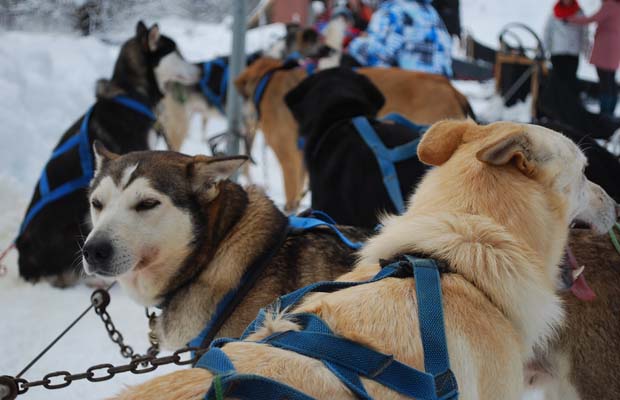
100 Canadian Sled Dogs Slaughtered


The “execution-style” mass cull of 100 sled dogs owned by Whistler-based Outdoor Adventures has sparked an SPCA investigation into allegations of animal cruelty, outrage from animal welfare groups and suspension by Tourism Whistler of reservations for dog sledding excursions by the company.


The cull came to light because of a successful WorkSafeBC claim for post-traumatic stress by the employee who killed the dogs over two days last April.
The worker said he suffered panic attacks and nightmares because of the grisly scenes that unfolded as he carried out the company’s orders to kill 100 of its 300 dogs because of a slow winter season.
Many were killed in mass shootings, carried out in front of each other, that caused the dogs to panic and attack him.
“By the end he was covered in blood,” according to the review board’s Jan. 25 decision that found he did suffer post-traumatic stress. “When he finished he cleared up the mess, filled in the mass grave and tried to bury the memories as deeply as he could.”
Five days after the final culling, he sought treatment from a clinical counsellor who indicated he was suffering from post-traumatic stress disorder.
The animal cruelty investigation came to light after WorkSafeBC’s Jan. 25 decision was made public.
The full report, by review officer Allan Wotherspoon, obtained by The Vancouver Sun, stated the worker’s “employer did not protest acceptance of the claim” nor did they provide any evidence to counter the worker’s declaration “thus I accept the worker’s account of what occurred with reservation.”


Wotherspon found the “‘mass cull’ was unique in its size, not only in respect of the workers’ experience but in all of Canada.”
Outdoors Adventures, which also offers snowmobiling, snowshoeing and horseback excursions in the Whistler area, did not return repeated phone calls from The Sun.
However, a statement by Outdoor Adventures spokesman Graham Aldcroft said there are now no firearms on site and any time a sled dog is euthanized in the future, it will be done in a vet’s office.
“While we were aware of the relocation and euthanization of dogs at “Howling Dog Tours,” we were completely unaware of the details of the incident until reading the WCB document Sunday,” he stated in the release.
Outdoor Adventures had a financial stake in ‘Howling Dogs’ which is owned by 29-year-old Joey Houssian, whom Piqué Magazine identifies as the son of Intrawest scion Joe Houssian. He is also listed as a director with Outdoor Adventures, which was incorporated in 1997.
Tourism Whistler, the official marketing and sales body for the resort, has suspended reservations for dog sledding activities with the company.
It is also offering money back to anyone who has already booked a dog sled tour with the company, said senior manager of communications Breton Murphy.
He said it’s too early to say whether the dog-cruelty allegations will hurt tourism generally to Whistler.
Marcie Moriarty, head of the BC SPCA cruelty investigations division, said the employee, who was the general manager at the time with Outdoor Adventures in Whistler, could have simply said no when his employer ordered him to kill the dogs.
The man said in a written declaration to the WorkSafeBC review that he had “developed a strong emotional bond of mutual love and trust with” the dogs before carrying out the “execution-style” mass cull over two days.
“I’ve no doubt he has suffered post traumatic stress but there’s a thing called choice,” said Moriarty. “I absolutely would not have done this and he could have said no. This is a Criminal Code offence … I don’t feel sorry for this guy for one minute.”
Moriarty said the man chose to shoot and kill the dogs on April 21 and April 23 inhumanely.
“The way this employee describes it — it’s a massacre absolutely — a criminal code offence. These dogs were killed in front of the other dogs that were all tethered up on the compound [where the dogs are kept for Outdoor Adventures].”
The BC SPCA animal cruelty investigators plan to execute a search warrant to try to obtain further information about the culling.
Murphy said that after he heard details of the allegations against the dog sled company, “to call it tragic is an understatement.”
“We’ve had a number of visitors contacting us and saying they’re concerned about this operator … We’ve talked to the operator and they understand what we’re doing.


“It makes sense to us to have a suspension on the sales [of dog sledding] through our channels. We’re trying to be appropriate and show due diligence until the allegations have been investigated … We have to watch and wait.”
Murphy said Tourism Whistler has been helping market the dog sled tours for the past six years and will continue to market Outdoor Adventures’ other activities except dog sledding.
He said visitors can still take dog sleds with two other companies — Canadian Snowmobile and Blackcomb Snowmobile.
The WorkSafeBC report states the employee, who had known a lot of the dogs and even named many of them, lived with them and cared for them seven days a week, Part of his duties including occasionally euthanizing animals, who were old, ill, injured or where there were unwanted puppies.
“All prior culls were done with the support and approval of a veterinarian,” the man stated in a written declaration to the review.
“A veterinarian was contacted, but refused to euthanize healthy animals. Attempts were made to adopt out the dogs with only limited success.”
The report did not state by what means the company or the worker tried to find alternative homes for the sled dogs.
But over a two-day period in late April, 2010 he agreed to carry out the orders from his employer to euthanize some of them because part of his job duties “included herd control.” But what made it difficult for him this time was the large number of animals involved.
“In the past, his practice when euthanizing a dog was to take it for a walk in the woods and give them a nice meat meal to distract them. That would make for a calm environment and kept the dogs away from the general population so as not to disrupt them. He would use a gun to euthanize the dogs,” the report states.
However, because of the large number of dogs he said he was forced to euthanize the dogs in full view of the other dogs and by about the 15th dog it appeared to him “the dogs were experiencing anxiety and stress from observing the euthanasia of other members of the pack and were panicking.”
His family physician also indicated the worker, who resides at the same location as the dogs with his family, complained of “panic attacks, nightmares, sleep disturbances, anger, irritability and depressed mood since culling approximately 100 dogs.” In addition to the post-traumatic stress disorder symptoms, he exhibited “dissociative symptoms.”
Moriarty said from what she’s read so far in the report “many people will be shocked” not only about the culling but how sled dogs are treated in general.
“There is a problem with the sled dog industry in general. People see these 20 sled dogs, an idyllic setting with snow in the background and think how great. But what they don’t see is the 200 dogs tethered and sleeping out back, chained to a barrel.”
She said from reading the report, it appears the request was made to kill the dogs because of a downturn in the business after the Olympics on the compound of Outdoor Adventures.
“What do they do when they don’t have the money to feed them all? When the dogs aren’t needed. The order to simply put them down is not acceptable.”
She said the SPCA plans to uncover the mass grave to examine the dogs’ remains but can’t do that immediately because the ground is frozen under several feet of snow.
Moriarty said she’s “glad a light is finally being shed on this industry. I just shudder whenever I see the ads for sled dog tours because I know how the majority of dogs are living. There are a few good operations but on a smaller scale.”


Vancouver Humane Society spokesman Peter Fricker said this isn’t the first time sled dogs have been hurt or killed by sled dog companies in Canada. He said the SPCA in Tumbler Ridge seized 34 badly neglected sled dogs in 2009.
“Our experience in every case where people use animals to make money and when there are financial difficulties the animals’ lives are put at risk.”
Fricker said the time has come for an outright ban on sled dog companies.
The NDP released a press release calling for the B.C. Liberals to begin funding animal protection work done by the BC SPCA, the only provincial body with specific authority to investigate animal cruelty complaints. The government provides zero dollars to animal protection.
David Greer, communications director with the Ministry of Citizens’ Services and Agriculture, said in an email to The Sun late Monday that the Prevention of Cruelty to Animals Act was amended in 2008 to stiffen potential penalties for those convicted of causing distress to an animal.
“The courts are now able to impose a lifetime ban on owning or possessing animals, up to six months in jail, and a fine of up to $5,000 for a first offence and $10,000 for any repeat offences.
“The amendments have also strengthened the authority of agents to seize evidence of an offence and take animals into custody.


Sunday, January 30, 2011

Breed: Fila Brasileiro


This very loyal and fearless guard dog looks like a cross between a Mastiff and a Bloodhound, and was originally bred to protect the Brazilian plantations of the 19th century. 
Centuries ago the ancestors of the Fila Brasileiro were crossed with Bloodhounds, Mastiffs and bulldogs brought to the new world by the Conquistadors. The resulting breed combined the great scenting ability of the Bloodhound, with power and fearless tenacity.
This made the Fila particularly suited to defend the ranches and cattle of the Minas Gerais region against thieves and jaguars. 


Filas were also useful on hunting journeys to track, attack and then hold the prey until the hunter arrived to take over. The word 'Fila' is, in fact, derived from a Portugese word meaning 'to hold' or 'to secure'. At one time this dog was also employed to track down and capture runaway slaves. 

It is probably the only breed that was selected for centuries to deeply dislike the humans they were not raised with, and, to this day, temperament tests run during championships require the dogs to attack without being coached, to remain self-confident during a shooting test, and to openly show their suspicion of strangers. The standard prescribes that, even at dog shows, Filas should not "allow the judge (a stranger) to touch it. And if it attacks the judge, such a reaction must not be considered a fault, but only a confirmation of its temperament." 
Another characteristic of the breed are  its loose joints in the legs and spine. As a results, the Fila is able to change route suddenly and quickly, even at a gallop.

Filas typically have a sad look when at rest, which becomes energetic and determined when on the alert. 

Fila Brasileiro FCI Standards:


This is taken from the 2004 version of the FCI standard, translated by Jennifer Mulholland & Raymond Triquet.


1. General Appearance
Typically a molossoid breed.  Powerful bones, rectangular and compact structure, but harmonious and well proportioned. Displays, together with a massive body, a great amount of concentrated agility which is easily perceived.  Bitches must show a well defined femininity which clearly distinguishes them from males. 
Important Proportions:
The muzzle is slightly shorter than the skull.

The length of the body, measured from the point of the sternum to the point of buttock, is equal to height at the withers plus 10%.

2. Temperament
Courage, determination and outstanding braveness are part of its characteristics.  With its owners and family it is docile, obedient and extremely tolerant with children.  Its loyalty is proverbial, insistingly seeking the company of its master. 
One of its characteristics is its aloofness towards strangers. It displays a calm disposition, distinctive self-assurance and self-confidence, remaining unperturbed by strange noises or circumstances. An unsurpassed guardian of properties, it also instinctively indulges in big game hunting and cattle herding.
Expression:
In repose it is calm; noble and full of self-assurance.  Never displaying a bored or absent expression.  When alert, its expression should reflect determination conveyed by a firm, penetrating look.

3. Head:
The Fila head is big, heavy and massive, always proportionate to the whole body.  From a top view it resembles a trapezoid figure into which a pear shape is inserted.

4. Skull:
The profile of the skull shows a smooth curve from the stop to the occiput, which is well defined and protuberant specially in puppies.  From a front view it is large, broad with the upper line slightly curved.  Lateral lines come down almost vertically, in a slight continuous curve narrowing towards the muzzle. 

5. Stop:
From a front view it is practically non existent.  The median groove is slight and runs up smoothly to approximately the centre of the skull.  Seen from the side, the stop is only slightly pronounced and virtually only formed by the well developed eyebrows.

6. Ears:
Pendant, large, thick, V-shaped.  Broad at the base and tapering to the ends.  Rounded tips.  Attached at the back of the skull, in line with the eyes when in repose.  When roused, the ears are above the original position. The root is oblique, with the front edge higher than the back edge. Falling over the cheeks or folded back showing the inside (rose ear).

7. Eyes:
From medium to large size, almond shaped, spaced well apart, medium to deep set.  Permissible colours - from dark brown to yellow, always in accordance to the colour of the coat.  Due to the  loose skin many individuals present drooping lower eyelids which are not considered a fault as such a detail accentuate the melancholic expression which is typical of the breed. 

8. Muzzle:
Strong, broad and deep, always in harmony with the skull.  Fairly deep at the root but not deeper than long.  Seen from above, it  is full under the eyes, slightly narrowing towards the middle of the muzzle and again broadening slightly to the front line.  Seen from the side, the muzzle is straight or has a Roman line, but never turned up.  The front line of the muzzle is almost perpendicular to the bridge of the nose with a slight depression right under the nose.

9. Lips:
The upper lip is thick and pendulous and overlaps the lower lip in a perfect curve; thus the lower line of the muzzle is almost parallel to the upper line. The lower lip is tight and firm to the fangs and from there on it is loose with dented borders ending at the corners which are always apparent.  The muzzle has a good depth at the root but without surpassing the length.  Edges of the lips form a deep inverted “U”.

10. Nose:
Well developed, broad nostrils not occupying entirely the width of the upper jaw.  Colour : black.

11. Teeth:
The teeth are significantly wider than long. Strong and white. Upper incisors are broad at their root and taper to the edge.  Canines are powerful, well set and well apart.  The ideal bite is a scissor bite but a level bite is acceptable.

12. Neck:
 Extraordinarily strong and muscled giving the impression of a short neck.  Slightly curved at the upper side and well detached from the skull.  Dewlaps at the throat.

13.Trunk:
Strong, broad and deep, covered by thick and loose skin.

14. Thorax:
The thorax is longer than the abdomen.

15. Flank:
Shorter and not so deep as the thorax, showing distinctly the separation of the two component parts.  In females the lower part of the flank is more developed.  Seen from above, the loin is narrower than the thorax and croup but should not form a waistline.

16. Topline:
Withers, in sloping line, are set well apart from each other due to the distance between the shoulder blades.  Withers are set lower than the croup.  After the withers, the upper line changes direction, ascending smoothly to the croup.  Back line shows no tendency to sway or roach back.

17. Lower line:
A long chest and parallel to the ground in all its extension.  Slightly tucked up but never whippety.

18. Chest:
Well sprung ribs though not interfering with the position of shoulder.  Deep and broad chest reaching to the level of the elbows.  Well pronounced brisket.

19. Croup:
Broad, long, sloping at angle of approximately 30 degrees to the horizontal and ending in a smooth curve. The croup is set a little higher than the withers.  From a back view, the croup is ample almost as wide as the chest and can be even  broader for females.

20. Forequarters:
The length of the leg, from the ground to the elbow, should be half of the height from the ground to the withers.
Shoulder:
The shoulder structure should be composed by two bones of equal length (scapula and humerus); the former at 45 degrees to the  horizontal and the latter 90 degrees to the scapula.  The scapla-humerus articulation forms the point of shoulder which is situated at the same level but slightly behind the point of sternum.  In the ideal position, the point of shoulder should be half way from elbow to withers.  An imaginary perpendicular line coming down from the withers should cut the elbow and reach the foot.

21. Legs:
Forearm: The limbs must be parallel.  Strong and straight bones.
Carpal joint (wrist): Strong and apparent.
Metacarpus (pastern): Short, slightly sloping.


22. Feet:
Strong and well arched toes not too close together.  The dog stands on thick toes and pads which are long, broad and deep.  In the correct position, the feet should point forward.  Strong, dark nails; white nails permissible when the corresponding toes are white.

23. Hindquarters:
Less heavy boned than forelegs but never appearing thin compared to the overall build. Hind legs are parallel.

24. Thigh:
Broad with curved outline shaped by strong muscles coming from the ilium and ischium which design the curve of the buttocks and for this reason the ischium must have a good length.

25. Leg:
Tarsus (hock) : Strong.
Metatarsus (Rear pastern) :  Slightly sloping, longer than the metacarpus.  Moderately angled stifle and hock.

26 Hind Feet:
A little more oval than the forefeet but the otherwise identical. Should not present dewclaws.

27. Tail:
Very wide at the root, medium set, tapering rapidly to reach the hocks. When the dog is alert, the tail is raised high and the curve at the extremity is more accentuated.  Should not be carried curled over the back nor touch it.

28. Skin:
One of the most important breed characteristics is the thick, loose skin over the whole body, chiefly at the neck forming pronounced dewlaps and many times it can extend to the brisket and abdomen.  Some individuals present a fold at the sides of the head, also at the withers running down to the shoulders. If the dog is in repose, the head should be free from wrinkles.  When alert, the dog raises its ears and the contraction of the skin on the skull forms small longitudinal wrinkles between the ears.

29. Coat:
Hair: Short, smooth, dense and close to the body.

30. Colors:
Any solid colours are permitted except the disqualifying ones.  Brindles with a solid coat and more or less dark stripes.
A black mask may or may not be present.  In all permitted colours white marks are allowed on the feet, chest and tip of tail.  White markings on other parts of the coat are considered a fault.

31. Gait:
Movement: Long and elastic feline-like strides whose principal  characteristic is the pace; a two beat lateral gait in which the legs of each side move back and forth exactly as a pair (“camel’s pace” or amble) causing a rolling or rocking motion of the thorax and hips accentuated by the tail when carried erect.  When walking, it carries the head lower than the back line. The trot is smooth, free and effortless with a long, powerful and reaching stride. The gallop is powerful, attaining unsuspected speed for such a large and heavy dog.  Due to its articulations, typical of molossoids, the Fila’s movements not only give the impression but actually allow him to make sudden and rapid changes of direction.

32. Height:
Height at withers: Males: from 65 cm (25.6 ins) to 75 cm (29.5 ins) at the shoulder.
Bitches: from 60 cm (23.6 ins) to 70 cm (27.5 ins) at the shoulder.

33. Weight:
Males: minimum: 50 kgs (100 pounds)
Bitches: minimum: 40 kgs (80 pounds).